Modernizing Legacy Software for an AI-Assisted Future: Architecture, Testing, and Maintenance After the Migration
Legacy modernization used to be framed mostly as a technology decision.
An aging ASP.NET application might move to Node.js. An old PHP monolith could be rebuilt around TypeScript and modern cloud infrastructure. A tightly coupled .NET system might be decomposed into cleaner modules or services.
Those decisions still matter. But there is now another question worth asking before the migration starts:
How will this system be maintained after the migration is finished?
AI coding tools can already investigate bugs, implement contained features, generate tests, update dependencies, and work through repetitive engineering tasks surprisingly well. That does not mean every modernized application should be designed to run without engineers. It does mean that the architecture we build today can make future AI-assisted maintenance either much easier or unnecessarily difficult. A successful modernization should therefore do more than replace an old framework. It should leave behind a system that is easier for both engineers and AI coding agents to understand, modify, test, and verify.
The Target Stack Is Only Part of the Decision
Consider two companies migrating similar ten-year-old .NET applications to Node.js and TypeScript.
The first application is mature.
Its core product changes rarely. Most future work will involve dependency updates, small integrations, minor business-rule changes, security fixes, and occasional improvements requested by existing users. The second application is still actively evolving. New workflows appear every month. Business rules change. New integrations are introduced. Developers regularly modify both the product and its underlying architecture. Both applications can benefit from AI-assisted development.
But they should not necessarily be optimized for the same maintenance model.
For the mature system, it may make sense to optimize heavily for predictable, isolated changes that can increasingly be handled by AI coding agents with human review. For the actively developed product, AI may write a substantial share of the implementation, but engineers will still be making architectural decisions, resolving unclear requirements, designing new domains, and deciding how the system should evolve. That difference should influence the migration from the beginning.
Modernize the Boundaries, Not Just the Language
One of the most common modernization mistakes is to recreate the old architecture in a new stack.
A tightly coupled PHP or .NET monolith becomes a tightly coupled Node.js application.
The syntax improves. Tooling improves. Hiring may become easier.
But many of the original maintenance problems remain.
For larger applications, modernization is often more useful when functionality is migrated gradually behind new boundaries.
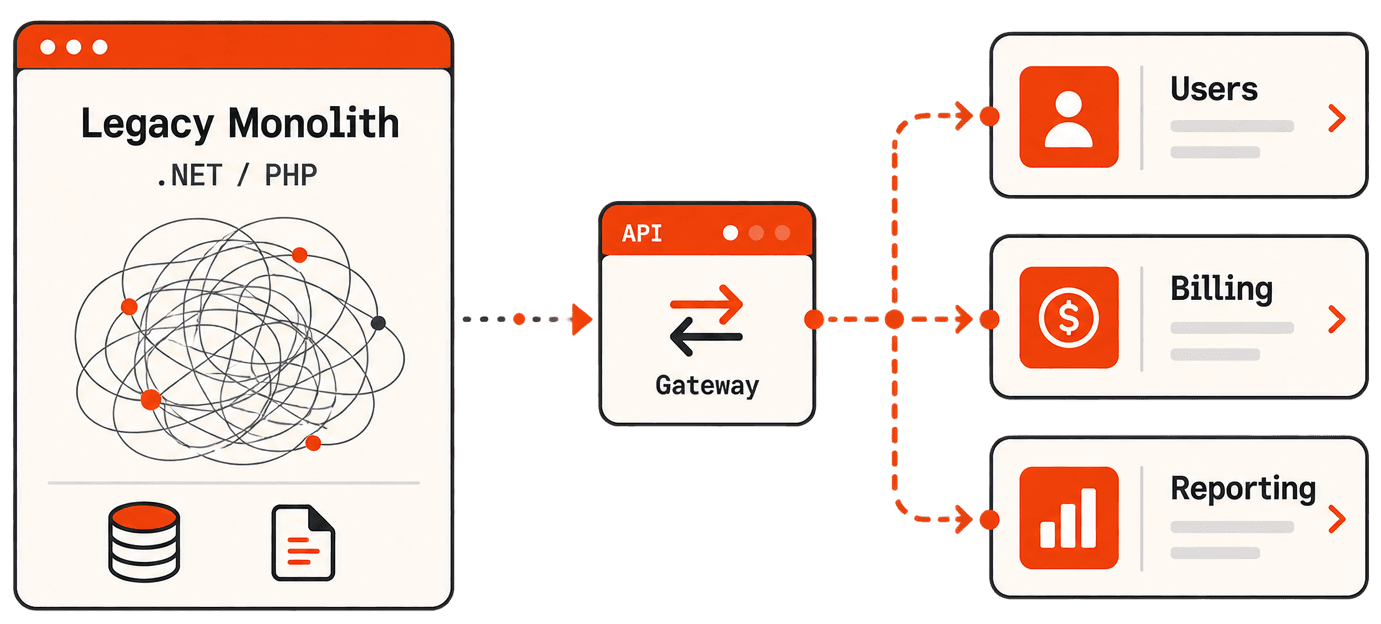
As the migration progresses, more functionality can move from the legacy application into independently understandable modules or APIs.
This does not mean every migration should become a microservices project.
In many cases, a modular Node.js application is simpler and easier to operate than dozens of independently deployed services.
The goal is not to maximize the number of components.
The goal is to create useful boundaries around functionality that can be understood and changed independently.
Those boundaries become particularly valuable when AI coding agents are involved.
An agent that needs to understand five repositories, a shared database, several undocumented conventions, and years of hidden dependencies before changing one rule is working with a difficult problem.
An agent working inside a clearly scoped module with explicit inputs, outputs, tests, and documentation has a much better chance of producing a safe change.
Designing Safe Change Zones for AI
A useful concept during modernization is the safe change zone.
This is a part of the application where a developer or AI coding agent can make a change without having to understand the entire system.
Take reporting as an example.
In a legacy application, reporting logic may directly depend on internal database tables, permissions, billing rules, shared helpers, and domain objects from several parts of the codebase.
A small change to a report may therefore require understanding far more of the system than expected.
During modernization, that functionality could instead be moved behind a clearly defined boundary.
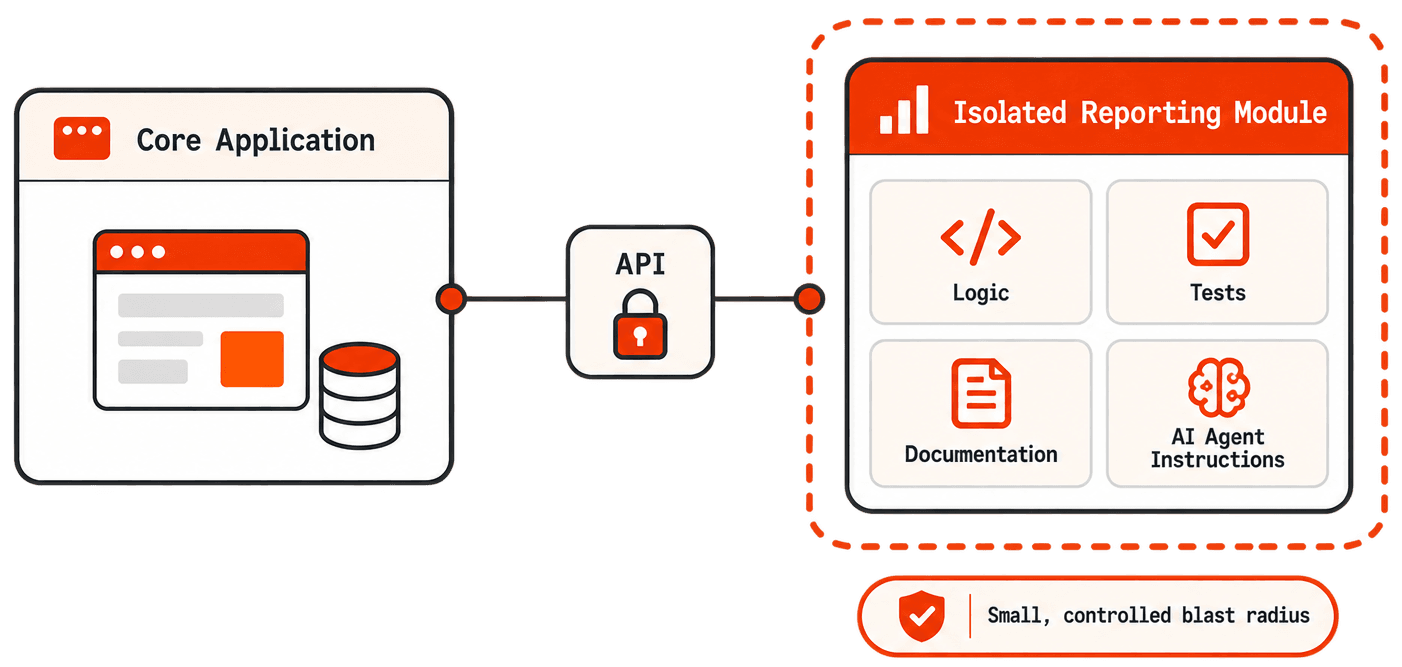 This does not have to mean separate infrastructure.
A well-structured module inside a larger application can provide many of the same benefits.
What matters is that its responsibilities and dependencies are clear.
A good AI-maintainable component usually has a few common properties.
Its inputs and outputs are explicit. Its dependencies are limited. Business assumptions are documented. Tests describe the expected behavior. Failures are observable. Changes can be verified without reconstructing the entire application mentally.
These qualities are useful for human developers too.
AI simply makes the cost of unclear architecture more obvious.
Poorly defined code forces an agent to infer intent from implementation.
Well-defined architecture gives it a constrained problem to solve.
Tests Become Part of the Architecture
Testing has always been important during modernization, but AI-assisted development gives it an additional role.
Tests are no longer only regression protection.
They also become an executable specification for future changes.
That is especially important when migrating legacy software, because old systems often contain years of undocumented business behavior.
Before replacing a workflow, the team should capture the behavior that must remain true.
For example:
User logs in
→ Creates an order
→ Discount rules are applied
→ Payment succeeds
→ Invoice is generated
Every implementation detail behind that flow may change during modernization.
The behavior should not.
End-to-end tests are therefore particularly useful around important business scenarios.
They allow the modernized implementation to be validated against what users actually depend on rather than against the internal structure of the old application.
API and contract tests protect newly introduced boundaries.
If the modernization creates endpoints such as:
POST /orders
GET /customers/:id
POST /reports/generate
their expected behavior should remain stable even while the implementation behind them evolves.
Unit and integration tests then provide faster feedback inside each component.
Together these layers create something extremely valuable for AI coding agents:
Understand task
→ Modify code
→ Run tests
→ Observe failure
→ Adjust implementation
→ Verify behavior
Without this loop, AI can still generate code.
But generating code and maintaining software safely are two very different things.
What We Would Change During an Actual .NET or PHP to Node.js Migration
The AI aspect should not become a separate modernization project.
Most of the useful changes are architectural improvements we would already want to make during a well-designed migration.
The difference is that today we would be more deliberate about them.
1. Extract Business Capabilities Behind Explicit Interfaces
Instead of directly translating large pieces of legacy code into equivalent Node.js classes or modules, identify business capabilities that can have clear boundaries.
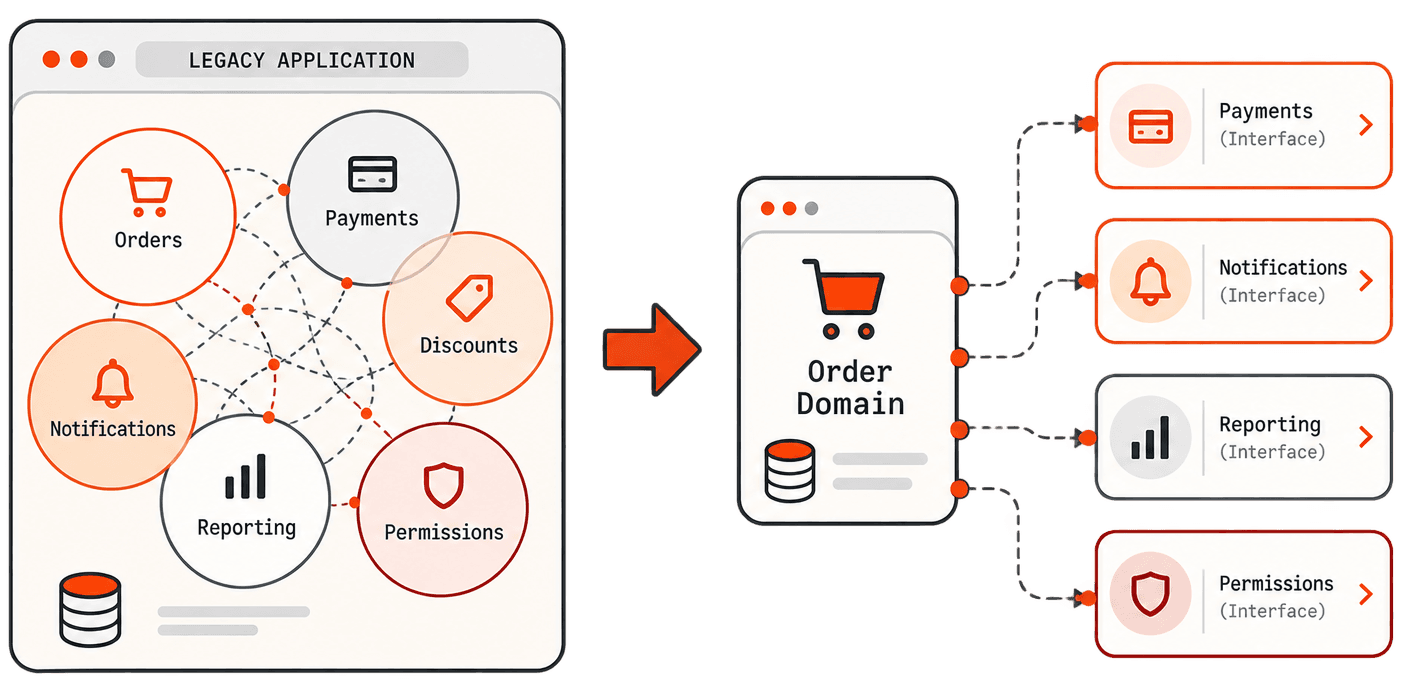
The goal is not necessarily separate deployments.
It is reducing the amount of context required to modify one area safely.
2. Separate Suitable Backend Logic Into Independently Testable Components
Some functionality is naturally easier to isolate than core transactional logic.
Examples may include:
- reporting;
- document generation;
- notifications;
- imports and exports;
- data transformation;
- third-party integrations;
- scheduled processing.
These areas can become good candidates for heavier AI-assisted maintenance because their contracts and expected outputs can often be described precisely.
They are also easier to test independently.
3. Add E2E Coverage Before Replacing Important Legacy Flows
Ideally, critical workflows should be tested while the old system is still running.
That gives the migration team a behavioral baseline.
Instead of asking whether the new implementation matches the old code internally, we can verify that:
Old implementation → same business outcome
New implementation → same business outcome
This is especially useful when the original business logic is poorly documented or distributed across many legacy classes and database procedures.
4. Replace Hidden Conventions With Repository-Level Instructions
Long-running projects often depend on knowledge that exists primarily in the development team.
For example:
Never call this service directly.
All customer updates must go through this method.
This database table looks unused but is consumed by a nightly job.
Run these three commands before changing billing.
That knowledge should become part of the repository.
It can live in architecture documentation, module READMEs, ADRs, or agent instruction files.
This makes onboarding easier for developers and gives coding agents much better context when making changes.
5. Make Verification Easy to Run Locally and in CI
A modernized component should ideally have an obvious way to answer:
Did this change work?
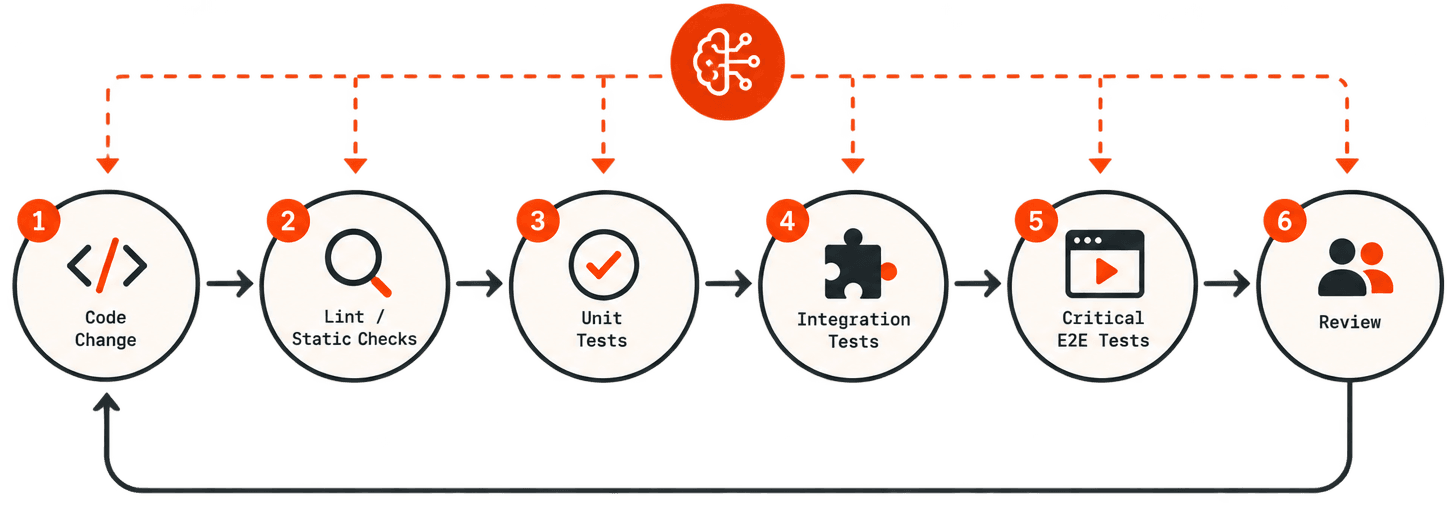 The easier this loop is to execute, the more useful AI agents become.
If every meaningful test requires access to an undocumented staging environment and three manual setup steps, autonomous maintenance becomes much harder.
6. Avoid Unnecessary Architectural Cleverness
Modernization projects can easily overcorrect.
A legacy monolith does not automatically need event sourcing, dozens of services, multiple queues, or a new infrastructure abstraction for every component.
Complex architectures increase the amount of context a developer or AI agent needs before making a safe change.
Unless complexity solves a real product or operational problem, simpler architecture usually creates a better long-term maintenance environment.
Two Different Maintenance Models
Once the new architecture starts taking shape, different parts of the system can be optimized for different levels of AI involvement.
Mostly Static Systems: Optimize for Predictability
Some applications eventually become relatively stable.
A customer portal, internal management system, established marketplace workflow, or mature back-office platform may continue running for years without significant architectural change.
Future tasks may mostly consist of:
- updating a validation rule;
- adding a field to an API;
- upgrading a dependency;
- adapting to a third-party API change;
- fixing a bug;
- modifying a report.
This type of system can be a strong candidate for AI-first maintenance.
The architecture should favor predictable behavior.
Stable interfaces help. Strong typing helps. Conservative dependencies help. Automated deployments and strong regression coverage help even more.
The repository should explain how the application is expected to be changed.
A future coding agent should be able to determine:
- how the system is structured;
- where a business rule belongs;
- which modules may depend on each other;
- how database migrations work;
- which tests should be run;
- what must be true before a change can be accepted.
For this type of application, a boring architecture is often a good architecture.
A simple system with explicit boundaries, strong tests, and limited surprises is exactly the kind of environment where AI can safely take on more routine maintenance work.
Actively Developed Products: Optimize for Evolution
The requirements are different when the product itself is still changing rapidly.
New domains appear.
Existing workflows are redesigned.
Data ownership changes.
New integrations introduce new constraints.
Scaling issues force architectural decisions that did not matter two years earlier.
AI coding tools can still handle a large amount of implementation work here.
They can create endpoints, refactor modules, write migrations, generate tests, investigate bugs, and implement defined features.
But many important engineering decisions happen before implementation begins.
Should this capability become a new domain?
Who should own this data?
Should two components communicate synchronously or asynchronously?
Does this performance issue justify additional architectural complexity?
Is an abstraction useful or are we generalizing too early?
What does an ambiguous business rule in the old PHP application actually mean?
AI is powerful once the problem is sufficiently defined.
Software architecture often requires defining the problem in the first place.
For actively developed products, engineers therefore remain responsible for steering architecture while AI increasingly accelerates implementation.
The objective is not to remove developers from the system.
It is to let humans and AI work at different levels of abstraction.
The Migration Should Leave a Development Harness Behind
A modernization project should deliver more than new source code.
It should leave behind the environment required to maintain that code efficiently.
For example:
/repository
  /services
      /billing
          README.md
          AGENTS.md
          tests/

      /reporting
          README.md
          AGENTS.md
          tests/

  /docs
      architecture.md
      domains.md
      integrations.md

  AGENTS.md
The exact naming is not important.
The principle is.
A future developer or coding agent should be able to answer basic questions without reverse-engineering the whole application.
What does this component own?
Which dependencies are allowed?
How do I test it?
What does a correct change look like?
Which areas require additional review?
The CI pipeline then provides the second half of that environment by automatically checking whether the change complies with those expectations.
In other words, the modernization deliverable becomes:
application code + context + automated verification.
That combination is much more valuable than a newer framework alone.
Not Every Part of the Application Needs the Same AI Autonomy
There is no reason to make every part of the application equally suitable for autonomous AI changes.
Different areas carry different levels of risk.
Reporting, notifications, document generation, admin tools, data transformation, or isolated integrations may be good candidates for heavily AI-assisted maintenance.
Core authorization, financial calculations, cross-domain database changes, major infrastructure decisions, or critical transactional workflows may require much stronger engineering oversight.
That distinction can be intentional.
Instead of asking:
Can AI maintain this system?
Ask:
Which parts of this system can we design so AI can modify them safely and independently?
That produces much more practical architecture decisions.
Modernization Is Ultimately About Making Change Cheaper
Moving an old ASP.NET, .NET, or PHP application to Node.js can remove important technical constraints.
But replacing the technology without changing the maintenance characteristics of the system leaves a large part of the opportunity untouched.
If the new application is still tightly coupled, poorly documented, difficult to test, and dependent on knowledge stored in a few developers' heads, the stack may be modern while the maintenance problem remains.
A better modernization target is a system with understandable boundaries, explicit contracts, reliable verification, and enough context for future maintainers to work confidently.
Those maintainers will increasingly include AI coding agents.
For mature applications, that may mean designing substantial parts of the system for AI-first maintenance.
For actively developed products, it means building an architecture where engineers continue making high-level decisions while AI handles more of the implementation and routine engineering work.